The Resolution of an Absurdist Play Often Sets the Cycle of Action in Motion Again.
Movement capture of two pianists' right hands playing the same piece (slow-motion, no-sound)[1]

Two repetitions of a walking sequence recorded using a motility-capture organisation[2]
Motion capture (sometimes referred as mo-cap or mocap, for short) is the process of recording the motion of objects or people. It is used in military, entertainment, sports, medical applications, and for validation of computer vision[3] and robots.[4] In filmmaking and video game development, information technology refers to recording actions of homo actors, and using that information to animate digital character models in 2-D or 3-D computer blitheness.[v] [6] [7] When it includes confront and fingers or captures subtle expressions, it is often referred to equally performance capture.[8] In many fields, motion capture is sometimes called movement tracking, but in filmmaking and games, motion tracking usually refers more to match moving.
In motion capture sessions, movements of one or more actors are sampled many times per second. Whereas early techniques used images from multiple cameras to summate 3D positions,[9] oft the purpose of motion capture is to record only the movements of the actor, non their visual appearance. This animation information is mapped to a 3D model so that the model performs the same actions as the thespian. This process may exist contrasted with the older technique of rotoscoping.
Camera movements can also be motility captured so that a virtual camera in the scene will pan, tilt or dolly around the stage driven by a photographic camera operator while the actor is performing. At the same time, the motion capture organization tin capture the camera and props equally well as the actor's functioning. This allows the computer-generated characters, images and sets to have the same perspective as the video images from the camera. A computer processes the data and displays the movements of the actor, providing the desired camera positions in terms of objects in the ready. Retroactively obtaining camera movement data from the captured footage is known as lucifer moving or camera tracking.
Advantages [edit]
Motion capture offers several advantages over traditional computer animation of a 3D model:
- Depression latency, close to existent time, results can be obtained. In amusement applications this can reduce the costs of keyframe-based animation.[10] The Manus Over technique is an example of this.
- The amount of work does not vary with the complexity or length of the performance to the same degree as when using traditional techniques. This allows many tests to be done with different styles or deliveries, giving a different personality merely limited by the talent of the thespian.
- Complex movement and realistic concrete interactions such as secondary motions, weight and commutation of forces can exist easily recreated in a physically authentic manner.[xi]
- The amount of blitheness data that can exist produced within a given time is extremely large when compared to traditional animation techniques. This contributes to both cost effectiveness and meeting production deadlines.[12]
- Potential for complimentary software and third party solutions reducing its costs.
Disadvantages [edit]
- Specific hardware and special software programs are required to obtain and procedure the information.
- The price of the software, equipment and personnel required can exist prohibitive for pocket-sized productions.
- The capture system may have specific requirements for the space it is operated in, depending on camera field of view or magnetic baloney.
- When problems occur, it is easier to shoot the scene again rather than trying to manipulate the information. Simply a few systems allow existent time viewing of the information to decide if the take needs to exist redone.
- The initial results are limited to what tin can exist performed within the capture volume without extra editing of the data.
- Move that does not follow the laws of physics cannot be captured.
- Traditional animation techniques, such as added emphasis on anticipation and follow through, secondary motion or manipulating the shape of the character, as with squash and stretch animation techniques, must be added later.
- If the computer model has different proportions from the capture subject, artifacts may occur. For instance, if a cartoon grapheme has large, oversized easily, these may intersect the character's body if the human performer is not conscientious with their physical movement.
Applications [edit]

Move capture performers from Buckinghamshire New University
Video games often use motion capture to animate athletes, martial artists, and other in-game characters.[13] [14] Every bit early as 1988, an early on class of motion capture was used to animate the 2nd player characters of Martech's video game Vixen (performed past model Corinne Russell)[15] and Magical Visitor's 2D arcade fighting game Last Apostle Puppet Evidence (to animate digitized sprites).[xvi] Motion capture was later notably used to animate the 3D character models in the Sega Model arcade games Virtua Fighter (1993)[17] [18] and Virtua Fighter 2 (1994).[19] In mid-1995, developer/publisher Acclaim Entertainment had its own in-business firm motion capture studio built into its headquarters.[14] Namco'south 1995 arcade game Soul Border used passive optical system markers for motion capture.[20]
Movies use motion capture for CG effects, in some cases replacing traditional cel animation, and for completely computer-generated creatures, such as Gollum, The Mummy, King Kong, Davy Jones from Pirates of the Caribbean, the Na'vi from the film Avatar, and Clu from Tron: Legacy. The Bully Goblin, the three Stone-trolls, many of the orcs and goblins in the 2012 film The Hobbit: An Unexpected Journey, and Smaug were created using motion capture.
The film Batman Forever (1995) used some movement capture for sure special effects. Warner Bros had acquired move capture technology from arcade video game visitor Acclaim Entertainment for apply in the film'south product.[21] Acclamation's 1995 video game of the same name also used the aforementioned motion capture technology to animate the digitized sprite graphics.[22]
Star Wars: Episode I – The Phantom Menace (1999) was the get-go feature-length film to include a main character created using move capture (that character existence Jar Jar Binks, played past Ahmed All-time), and Indian-American film Sinbad: Beyond the Veil of Mists (2000) was the beginning feature-length film made primarily with motion capture, although many grapheme animators as well worked on the pic, which had a very express release. 2001's Concluding Fantasy: The Spirits Within was the first widely released movie to be made primarily with move capture applied science. Despite its poor box-office intake, supporters of movement capture technology took notice. Total Call up had already used the technique, in the scene of the x-ray scanner and the skeletons.
The Lord of the Rings: The Two Towers was the first feature motion-picture show to utilize a real-fourth dimension motion capture arrangement. This method streamed the actions of role player Andy Serkis into the calculator generated pare of Gollum / Smeagol as it was being performed.[23]
Out of the three nominees for the 2006 Academy Honour for All-time Animated Characteristic, 2 of the nominees (Monster House and the winner Happy Feet) used motion capture, and just Disney·Pixar's Cars was animated without motion capture. In the ending credits of Pixar's film Ratatouille, a postage appears labelling the picture as "100% Pure Animation – No Motion Capture!"
Since 2001, motion capture is existence used extensively to simulate or approximate the look of live-action movie theatre, with nearly photorealistic digital graphic symbol models. The Polar Express used motion capture to allow Tom Hanks to perform as several singled-out digital characters (in which he likewise provided the voices). The 2007 accommodation of the saga Beowulf animated digital characters whose appearances were based in part on the actors who provided their motions and voices. James Cameron's highly popular Avatar used this technique to create the Na'six that inhabit Pandora. The Walt Disney Company has produced Robert Zemeckis's A Christmas Carol using this technique. In 2007, Disney acquired Zemeckis' ImageMovers Digital (that produces motion capture films), simply and so closed it in 2011, after a box office failure of Mars Needs Moms.
Telly series produced entirely with motion capture animation include Laflaque in Canada, Sprookjesboom and Buffet de Wereld [nl] in The Netherlands, and Headcases in the UK.
Virtual reality and Augmented reality providers, such equally uSens and Gestigon, allow users to interact with digital content in real time by capturing hand motions. This tin can exist useful for training simulations, visual perception tests, or performing a virtual walk-throughs in a 3D environment. Motility capture technology is frequently used in digital puppetry systems to drive estimator generated characters in real-time.
Gait analysis is one awarding of move capture in clinical medicine. Techniques allow clinicians to evaluate human motility across several biomechanical factors, ofttimes while streaming this information live into analytical software.
Some physical therapy clinics utilize motion capture as an objective way to quantify patient progress.[24]
During the filming of James Cameron'southward Avatar all of the scenes involving this procedure were directed in realtime using Autodesk MotionBuilder software to render a screen image which allowed the director and the actor to see what they would expect like in the movie, making it easier to direct the movie as it would exist seen by the viewer. This method allowed views and angles not possible from a pre-rendered animation. Cameron was and then proud of his results that he invited Steven Spielberg and George Lucas on prepare to view the system in action.
In Curiosity'southward The Avengers, Mark Ruffalo used motion capture so he could play his character the Hulk, rather than take him be only CGI as in previous films, making Ruffalo the first actor to play both the human and the Blob versions of Bruce Imprint.
FaceRig software uses facial recognition technology from ULSee.Inc to map a actor's facial expressions and the body tracking technology from Perception Neuron to map the body move onto a 3D or 2D graphic symbol's motility onscreen.[25] [26]
During Game Developers Conference 2016 in San Francisco Epic Games demonstrated full-body motion capture live in Unreal Engine. The whole scene, from the upcoming game Hellblade about a adult female warrior named Senua, was rendered in real-time. The keynote[27] was a collaboration betwixt Unreal Engine, Ninja Theory, 3Lateral, Cubic Move, IKinema and Xsens.
Indian film Adipurush based on Ramayana. The picture is said to be a magnum opus using loftier-finish and existent-time technology such as Xsens motion capture and facial capture used past Hollywood to bring the earth of Adipurush to life. Adipurush is the story of Lord Ram.
Methods and systems [edit]
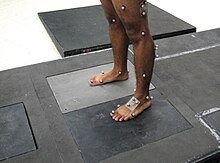
Cogitating markers fastened to skin to place torso landmarks and the 3D motion of torso segments

Motility tracking or motion capture started as a photogrammetric assay tool in biomechanics research in the 1970s and 1980s, and expanded into educational activity, training, sports and recently computer animation for goggle box, movie theater, and video games as the technology matured. Since the 20th century the performer has to wearable markers about each joint to identify the move past the positions or angles between the markers. Audio-visual, inertial, LED, magnetic or reflective markers, or combinations of whatsoever of these, are tracked, optimally at least two times the frequency rate of the desired motion. The resolution of the organization is important in both the spatial resolution and temporal resolution as move mistiness causes almost the aforementioned issues as low resolution. Since the beginning of the 21st century and because of the rapid growth of engineering science new methods were developed. Most modern systems can excerpt the silhouette of the performer from the groundwork. Afterwards all joint angles are calculated by plumbing equipment in a mathematic model into the silhouette. For movements y'all tin't meet a modify of the silhouette, there are hybrid Systems available who can do both (marker and silhouette), simply with less marker.[ citation needed ] In robotics, some move capture systems are based on simultaneous localization and mapping.[28]
Optical systems [edit]
Optical systems utilize data captured from image sensors to triangulate the 3D position of a subject between 2 or more cameras calibrated to provide overlapping projections. Data acquisition is traditionally implemented using special markers attached to an actor; however, more contempo systems are able to generate accurate information by tracking surface features identified dynamically for each item subject. Tracking a large number of performers or expanding the capture area is accomplished past the addition of more cameras. These systems produce data with three degrees of freedom for each marker, and rotational information must exist inferred from the relative orientation of three or more markers; for instance shoulder, elbow and wrist markers providing the angle of the elbow. Newer hybrid systems are combining inertial sensors with optical sensors to reduce apoplexy, increase the number of users and improve the ability to track without having to manually make clean up data[ citation needed ].
Passive markers [edit]

A dancer wearing a adjust used in an optical motion capture system

Markers are placed at specific points on an actor's face up during facial optical motility capture.
Passive optical systems utilize markers coated with a retroreflective material to reflect light that is generated near the cameras lens. The camera'southward threshold tin be adjusted so only the vivid reflective markers will be sampled, ignoring skin and cloth.
The centroid of the marking is estimated as a position inside the two-dimensional epitome that is captured. The grayscale value of each pixel can be used to provide sub-pixel accurateness by finding the centroid of the Gaussian.
An object with markers fastened at known positions is used to calibrate the cameras and obtain their positions and the lens distortion of each camera is measured. If two calibrated cameras see a marker, a three-dimensional fix can exist obtained. Typically a system volition consist of around 2 to 48 cameras. Systems of over three hundred cameras exist to endeavour to reduce marker swap. Actress cameras are required for full coverage around the capture subject field and multiple subjects.
Vendors have constraint software to reduce the problem of marker swapping since all passive markers appear identical. Different agile marker systems and magnetic systems, passive systems do non crave the user to wearable wires or electronic equipment.[29] Instead, hundreds of rubber assurance are attached with cogitating tape, which needs to exist replaced periodically. The markers are normally attached directly to the skin (as in biomechanics), or they are velcroed to a performer wearing a full-body spandex/lycra arrange designed specifically for motion capture. This type of system can capture large numbers of markers at frame rates unremarkably around 120 to 160 fps although by lowering the resolution and tracking a smaller region of interest they can track every bit high as 10,000 fps.
Agile mark [edit]

Active optical systems triangulate positions past illuminating one LED at a time very speedily or multiple LEDs with software to identify them by their relative positions, somewhat akin to celestial navigation. Rather than reflecting calorie-free back that is generated externally, the markers themselves are powered to emit their own light. Since inverse square police force provides one quarter the power at ii times the distance, this can increase the distances and volume for capture. This also enables high signal-to-noise ratio, resulting in very depression marker jitter and a resulting high measurement resolution (oftentimes downwards to 0.1 mm within the calibrated volume).
The TV series Stargate SG1 produced episodes using an active optical system for the VFX allowing the histrion to walk effectually props that would make move capture difficult for other non-active optical systems.[ commendation needed ]
ILM used active markers in Van Helsing to allow capture of Dracula'southward flying brides on very large sets similar to Weta'due south use of active markers in Ascent of the Planet of the Apes. The power to each marker can be provided sequentially in phase with the capture system providing a unique identification of each mark for a given capture frame at a cost to the resultant frame charge per unit. The power to place each marking in this manner is useful in realtime applications. The alternative method of identifying markers is to practice it algorithmically requiring extra processing of the data.
There are likewise possibilities to find the position by using coloured LED markers. In these systems, each colour is assigned to a specific point of the body.
1 of the primeval agile marker systems in the 1980s was a hybrid passive-active mocap system with rotating mirrors and colored glass cogitating markers and which used masked linear array detectors.
Time modulated active marker [edit]

A high-resolution uniquely identified agile marker system with 3,600 × iii,600 resolution at 960 hertz providing real time submillimeter positions
Agile marker systems can further be refined by strobing one marker on at a time, or tracking multiple markers over time and modulating the aamplitude or pulse width to provide marker ID. 12 megapixel spatial resolution modulated systems bear witness more than subtle movements than four megapixel optical systems by having both higher spatial and temporal resolution. Directors tin see the actors performance in real fourth dimension, and watch the results on the motion capture driven CG grapheme. The unique mark IDs reduce the turnaround, past eliminating marker swapping and providing much cleaner data than other technologies. LEDs with onboard processing and a radio synchronization permit motion capture outdoors in direct sunlight, while capturing at 120 to 960 frames per second due to a high speed electronic shutter. Computer processing of modulated IDs allows less mitt cleanup or filtered results for lower operational costs. This higher accuracy and resolution requires more processing than passive technologies, but the additional processing is done at the camera to improve resolution via a subpixel or centroid processing, providing both high resolution and high speed. These motion capture systems are typically $twenty,000 for an 8 photographic camera, 12 megapixel spatial resolution 120 hertz system with 1 actor.
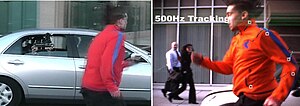
IR sensors tin compute their location when lit by mobile multi-LED emitters, e.one thousand. in a moving car. With Id per marker, these sensor tags can be worn nether clothing and tracked at 500 Hz in broad daylight.
Semi-passive ephemeral mark [edit]
Ane can opposite the traditional arroyo based on loftier speed cameras. Systems such as Prakash use inexpensive multi-LED high speed projectors. The specially built multi-LED IR projectors optically encode the space. Instead of retro-reflective or active light emitting diode (LED) markers, the system uses photosensitive marker tags to decode the optical signals. Past attaching tags with photo sensors to scene points, the tags can compute not but their ain locations of each indicate, but also their ain orientation, incident illumination, and reflectance.
These tracking tags work in natural lighting weather condition and can be imperceptibly embedded in attire or other objects. The organization supports an unlimited number of tags in a scene, with each tag uniquely identified to eliminate mark reacquisition problems. Since the system eliminates a high speed photographic camera and the corresponding loftier-speed paradigm stream, it requires significantly lower data bandwidth. The tags also provide incident illumination data which can be used to match scene lighting when inserting synthetic elements. The technique appears platonic for on-set move capture or real-time broadcasting of virtual sets just has even so to be proven.
Underwater motion capture organization [edit]
Motion capture technology has been bachelor for researchers and scientists for a few decades, which has given new insight into many fields.
Underwater cameras [edit]
The vital part of the system, the underwater camera, has a waterproof housing. The housing has a finish that withstands corrosion and chlorine which makes it perfect for utilize in basins and swimming pools. There are two types of cameras. Industrial loftier-speed-cameras tin as well exist used as infrared cameras. The infrared underwater cameras comes with a cyan calorie-free strobe instead of the typical IR light—for minimum falloff under water and the high-speed-cameras cone with an LED lite or with the choice of using image processing.

Underwater motion capture camera

Move tracking in swimming by using epitome processing
Measurement volume [edit]
An underwater camera is typically able to measure 15–20 meters depending on the h2o quality, the camera and the type of marker used. Unsurprisingly, the best range is achieved when the water is clear, and like always, the measurement book is besides dependent on the number of cameras. A range of underwater markers are available for different circumstances.
Tailored [edit]
Dissimilar pools require unlike mountings and fixtures. Therefore, all underwater motility capture systems are uniquely tailored to conform each specific pool installment. For cameras placed in the centre of the pool, specially designed tripods, using suction cups, are provided.
Markerless [edit]
Emerging techniques and research in computer vision are leading to the rapid evolution of the markerless arroyo to movement capture. Markerless systems such equally those developed at Stanford Academy, the University of Maryland, MIT, and the Max Planck Institute, practice not require subjects to wear special equipment for tracking. Special computer algorithms are designed to permit the system to analyze multiple streams of optical input and place human forms, breaking them downwardly into elective parts for tracking. ESC entertainment, a subsidiary of Warner Brothers Pictures created peculiarly to enable virtual cinematography, including photorealistic digital look-alikes for filming The Matrix Reloaded and The Matrix Revolutions movies, used a technique called Universal Capture that utilized 7 camera setup and the tracking the optical flow of all pixels over all the ii-D planes of the cameras for motion, gesture and facial expression capture leading to photorealistic results.
Traditional systems [edit]
Traditionally markerless optical move tracking is used to keep track on various objects, including airplanes, launch vehicles, missiles and satellites. Many of such optical motion tracking applications occur outdoors, requiring differing lens and photographic camera configurations. High resolution images of the target being tracked can thereby provide more information than simply motion data. The image obtained from NASA's long-range tracking arrangement on infinite shuttle Challenger's fatal launch provided crucial bear witness nearly the crusade of the accident. Optical tracking systems are as well used to identify known spacecraft and space debris despite the fact that it has a disadvantage compared to radar in that the objects must be reflecting or emitting sufficient lite.[thirty]
An optical tracking organisation typically consists of iii subsystems: the optical imaging system, the mechanical tracking platform and the tracking computer.
The optical imaging organisation is responsible for converting the light from the target expanse into digital prototype that the tracking computer tin process. Depending on the pattern of the optical tracking system, the optical imaging arrangement can vary from as simple every bit a standard digital camera to as specialized as an astronomical telescope on the top of a mountain. The specification of the optical imaging system determines the upper-limit of the effective range of the tracking arrangement.
The mechanical tracking platform holds the optical imaging organisation and is responsible for manipulating the optical imaging arrangement in such a mode that it always points to the target being tracked. The dynamics of the mechanical tracking platform combined with the optical imaging system determines the tracking system'southward ability to keep the lock on a target that changes speed speedily.
The tracking computer is responsible for capturing the images from the optical imaging system, analyzing the paradigm to extract target position and controlling the mechanical tracking platform to follow the target. There are several challenges. First the tracking computer has to be able to capture the image at a relatively high frame rate. This posts a requirement on the bandwidth of the epitome capturing hardware. The second claiming is that the image processing software has to be able to extract the target image from its groundwork and calculate its position. Several textbook image processing algorithms are designed for this task. This trouble tin can be simplified if the tracking system can wait certain characteristics that is common in all the targets information technology volition rails. The next problem downwardly the line is to command the tracking platform to follow the target. This is a typical command arrangement design problem rather than a challenge, which involves modeling the arrangement dynamics and designing controllers to control information technology. This will however become a challenge if the tracking platform the organization has to work with is not designed for real-time.
The software that runs such systems are also customized for the respective hardware components. Ane example of such software is OpticTracker, which controls computerized telescopes to rail moving objects at bang-up distances, such as planes and satellites. Some other selection is the software SimiShape, which can also exist used hybrid in combination with markers.
RGB-D Cameras [edit]
RGB-D cameras such every bit kinect captures both the color and depth images. By fusing the two images, 3D colored volex tin be captured, allowing motion capture of 3D human motion and homo surface in real time.
Because of the use of a single-view camera, motions captured are unremarkably noisy. Machine learning techniques take been proposed to automatically reconstruct such noisy motions into higher quality ones, using methods such every bit lazy learning[31] and Gaussian models.[32] Such method generate accurate enough motion for serious applications like ergonomic assessment.[33]
Not-optical systems [edit]
Inertial systems [edit]
Inertial motion capture[34] technology is based on miniature inertial sensors, biomechanical models and sensor fusion algorithms.[35] The motion information of the inertial sensors (inertial guidance system) is often transmitted wirelessly to a calculator, where the move is recorded or viewed. Nigh inertial systems use inertial measurement units (IMUs) containing a combination of gyroscope, magnetometer, and accelerometer, to measure rotational rates. These rotations are translated to a skeleton in the software. Much similar optical markers, the more IMU sensors the more natural the data. No external cameras, emitters or markers are needed for relative motions, although they are required to requite the accented position of the user if desired. Inertial motion capture systems capture the full vi degrees of liberty body motion of a man in real-time and can give limited direction information if they include a magnetic bearing sensor, although these are much lower resolution and susceptible to electromagnetic noise. Benefits of using Inertial systems include: capturing in a variety of environments including tight spaces, no solving, portability, and large capture areas. Disadvantages include lower positional accuracy and positional migrate which can chemical compound over fourth dimension. These systems are like to the Wii controllers but are more sensitive and have greater resolution and update rates. They can accurately measure the management to the footing to within a degree. The popularity of inertial systems is ascension among game developers,[10] mainly because of the quick and easy prepare up resulting in a fast pipeline. A range of suits are now available from various manufacturers and base of operations prices range from $one,000 to US$eighty,000.
Mechanical motion [edit]
Mechanical motion capture systems directly runway body joint angles and are often referred to as exoskeleton move capture systems, due to the way the sensors are attached to the torso. A performer attaches the skeletal-like structure to their body and as they move then practice the articulated mechanical parts, measuring the performer's relative motion. Mechanical motion capture systems are real-time, relatively low-cost, gratuitous from occlusion, and wireless (untethered) systems that have unlimited capture volume. Typically, they are rigid structures of jointed, directly metal or plastic rods linked together with potentiometers that articulate at the joints of the body. These suits tend to be in the $25,000 to $75,000 range plus an external absolute positioning system. Some suits provide limited force feedback or haptic input.
Magnetic systems [edit]
Magnetic systems calculate position and orientation by the relative magnetic flux of iii orthogonal coils on both the transmitter and each receiver.[36] The relative intensity of the voltage or electric current of the three coils allows these systems to calculate both range and orientation by meticulously mapping the tracking book. The sensor output is 6DOF, which provides useful results obtained with two-thirds the number of markers required in optical systems; one on upper arm and i on lower arm for elbow position and bending.[ citation needed ] The markers are not occluded by nonmetallic objects but are susceptible to magnetic and electrical interference from metallic objects in the environment, like rebar (steel reinforcing bars in physical) or wiring, which affect the magnetic field, and electrical sources such as monitors, lights, cables and computers. The sensor response is nonlinear, specially toward edges of the capture surface area. The wiring from the sensors tends to preclude extreme operation movements.[36] With magnetic systems, it is possible to monitor the results of a motion capture session in existent time.[36] The capture volumes for magnetic systems are dramatically smaller than they are for optical systems. With the magnetic systems, there is a distinction between alternate-current(AC) and direct-electric current(DC) systems: DC system uses square pulses, AC systems uses sine wave pulse.
Stretch sensors [edit]
Stretch sensors are flexible parallel plate capacitors that measure out either stretch, bend, shear, or pressure and are typically produced from silicone. When the sensor stretches or squeezes its capacitance value changes. This data can be transmitted via Bluetooth or direct input and used to detect infinitesimal changes in trunk motility. Stretch sensors are unaffected by magnetic interference and are free from occlusion. The stretchable nature of the sensors likewise means they do non endure from positional migrate, which is mutual with inertial systems. Stretchable sensors, on the other hands, due to the cloth backdrop of their substrates and conducting materials, suffer from relatively loftier bespeak-to-noise ratio, requiring filtering or machine learning to make them usable for motion capture. These solutions upshot in higher latency when compared to alternative sensors.
[edit]
Facial move capture [edit]
Most traditional movement capture hardware vendors provide for some blazon of low resolution facial capture utilizing anywhere from 32 to 300 markers with either an active or passive marker system. All of these solutions are limited by the time it takes to employ the markers, calibrate the positions and process the data. Ultimately the applied science besides limits their resolution and raw output quality levels.
High fidelity facial move capture, also known every bit performance capture, is the next generation of fidelity and is utilized to record the more than circuitous movements in a human being face up in society to capture higher degrees of emotion. Facial capture is currently arranging itself in several distinct camps, including traditional motion capture data, blend shaped based solutions, capturing the actual topology of an actor'south face, and proprietary systems.
The two main techniques are stationary systems with an assortment of cameras capturing the facial expressions from multiple angles and using software such every bit the stereo mesh solver from OpenCV to create a 3D surface mesh, or to employ light arrays as well to summate the surface normals from the variance in brightness as the light source, camera position or both are changed. These techniques tend to be only limited in feature resolution past the camera resolution, apparent object size and number of cameras. If the users face up is 50 percent of the working expanse of the camera and a camera has megapixel resolution, then sub millimeter facial motions can be detected by comparing frames. Recent work is focusing on increasing the frame rates and doing optical flow to allow the motions to be retargeted to other computer generated faces, rather than but making a 3D Mesh of the player and their expressions.
RF positioning [edit]
RF (radio frequency) positioning systems are becoming more viable[ citation needed ] as higher frequency RF devices allow greater precision than older RF technologies such as traditional radar. The speed of low-cal is 30 centimeters per nanosecond (billionth of a 2d), so a x gigahertz (billion cycles per second) RF indicate enables an accuracy of virtually iii centimeters. By measuring amplitude to a quarter wavelength, it is possible to improve the resolution downwardly to near eight mm. To accomplish the resolution of optical systems, frequencies of 50 gigahertz or college are needed, which are almost as dependant on line of sight and as easy to block equally optical systems. Multipath and reradiation of the signal are likely to crusade additional problems, simply these technologies volition be ideal for tracking larger volumes with reasonable accuracy, since the required resolution at 100 meter distances is not likely to be as high. Many RF scientists[ who? ] believe that radio frequency volition never produce the accuracy required for motion capture.
Researchers at Massachusetts Establish of Technology researchers said in 2015 that they had made a arrangement that tracks movement past RF signals, chosen RF Tracking.[37]
Non-traditional systems [edit]
An culling arroyo was adult where the role player is given an unlimited walking area through the use of a rotating sphere, similar to a hamster brawl, which contains internal sensors recording the angular movements, removing the need for external cameras and other equipment. Even though this technology could potentially pb to much lower costs for motion capture, the basic sphere is simply capable of recording a single continuous direction. Additional sensors worn on the person would exist needed to record anything more.
Another alternative is using a 6DOF (Degrees of liberty) motion platform with an integrated omni-directional treadmill with high resolution optical move capture to achieve the same effect. The captured person tin walk in an unlimited surface area, negotiating different uneven terrains. Applications include medical rehabilitation for rest training, bio-mechanical research and virtual reality.[ citation needed ]
3D pose estimation [edit]
In 3D pose estimation, an actor's pose can exist reconstructed from an paradigm or depth map.[38]
See also [edit]
- Blitheness database
- Gesture recognition
- Finger tracking
- Changed kinematics (a different way of making CGI effects realistic)
- Kinect (created by Microsoft Corporation)
- List of motion and gesture file formats
- Motion capture acting
- Video tracking
- VR positional tracking
References [edit]
- ^ Goebl, West.; Palmer, C. (2013). Balasubramaniam, Ramesh (ed.). "Temporal Control and Paw Movement Efficiency in Skilled Music Performance". PLOS ONE. viii (i): e50901. Bibcode:2013PLoSO...850901G. doi:x.1371/journal.pone.0050901. PMC3536780. PMID 23300946.
- ^ Olsen, NL; Markussen, B; Raket, LL (2018), "Simultaneous inference for misaligned multivariate functional data", Journal of the Imperial Statistical Order, Series C, 67 (5): 1147–76, arXiv:1606.03295, doi:x.1111/rssc.12276, S2CID 88515233
- ^ David Noonan, Peter Mountney, Daniel Elson, Ara Darzi and Guang-Zhong Yang. A Stereoscopic Fibroscope for Photographic camera Motility and 3-D Depth Recovery During Minimally Invasive Surgery. In proc ICRA 2009, pp. 4463–68. http://www.sciweavers.org/external.php?u=http%3A%2F%2Fwww.md.ic.air-conditioning.uk%2F%7Epmountne%2Fpublications%2FICRA%25202009.pdf&p=ieee
- ^ Yamane, Katsu, and Jessica Hodgins. "Simultaneous tracking and balancing of humanoid robots for imitating human move capture data." Intelligent Robots and Systems, 2009. IROS 2009. IEEE/RSJ International Briefing on. IEEE, 2009.
- ^ NY Castings, Joe Gatt, Motion Capture Actors: Body Movement Tells the Story Archived 2014-07-03 at the Wayback Machine, Accessed June 21, 2014
- ^ Andrew Harris Salomon, Feb. 22, 2013, Backstage Magazine, Growth In Performance Capture Helping Gaming Actors Weather Slump, Accessed June 21, 2014, "..Just developments in motion-capture technology, as well every bit new gaming consoles expected from Sony and Microsoft inside the year, indicate that this niche continues to be a growth area for actors. And for those who have thought about breaking in, the message is clear: Become busy...."
- ^ Ben Child, 12 Baronial 2011, The Guardian, Andy Serkis: why won't Oscars get ape over motion-capture acting? Star of Ascension of the Planet of the Apes says performance capture is misunderstood and its actors deserve more respect, Accessed June 21, 2014
- ^ Hugh Hart, January 24, 2012, Wired magazine, When will a motion capture actor win an Oscar?, Accessed June 21, 2014, "...the University of Motion Picture Arts and Sciences' historic reluctance to honour motion-capture performances .. Serkis, garbed in a sensor-embedded Lycra body accommodate, quickly mastered the then-novel art and scientific discipline of operation-capture acting. ..."
- ^ Cheung, German KM, et al. "A real time organisation for robust 3D voxel reconstruction of human being motions." Estimator Vision and Pattern Recognition, 2000. Proceedings. IEEE Conference on. Vol. 2. IEEE, 2000.
- ^ a b "Xsens MVN Breathing – Products". Xsens 3D movement tracking . Retrieved 2019-01-22 .
- ^ "The Next Generation 1996 Lexicon A to Z: Motion Capture". Next Generation. No. fifteen. Imagine Media. March 1996. p. 37.
- ^ "Motility Capture". Next Generation. Imagine Media (10): 50. October 1995.
- ^ Jon Radoff, Beefcake of an MMORPG, "Archived re-create". Archived from the original on 2009-12-13. Retrieved 2009-11-30 .
{{cite spider web}}: CS1 maint: archived copy as title (link) - ^ a b "Hooray for Hollywood! Acclaim Studios". GamePro. IDG (82): 28–29. July 1995.
- ^ Mason, Graeme. "Martech Games - The Personality People". Retro Gamer. No. 133. p. 51.
- ^ "Pre-Street Fighter II Fighting Games". Hardcore Gaming 101. p. 8. Retrieved 26 November 2021.
- ^ "Sega Saturn exclusive! Virtua Fighter: fighting in the tertiary dimension" (PDF). Calculator and Video Games. No. 158 (January 1995). Future plc. xv December 1994. pp. 12–three, xv–6, 19.
- ^ "Virtua Fighter". Maximum: The Video Game Mag. Emap International Limited (1): 142–3. October 1995.
- ^ Wawro, Alex (October 23, 2014). "Yu Suzuki Recalls Using Military Tech to Make Virtua Fighter 2". Gamasutra . Retrieved eighteen August 2016.
- ^ "History of Motion Capture". Motioncapturesociety.com. Archived from the original on 2018-10-23. Retrieved 2013-08-10 .
- ^ "Coin-Op News: Acclamation technology tapped for "Batman" movie". Play Meter. Vol. 20, no. 11. October 1994. p. 22.
- ^ "Acclamation Stakes its Claim". RePlay. Vol. 20, no. 4. January 1995. p. 71.
- ^ Savage, Annaliza (12 July 2012). "Gollum Actor: How New Movement-Capture Tech Improved The Hobbit". Wired . Retrieved 29 January 2017.
- ^ "Markerless Motion Capture | EuMotus". Markerless Motion Capture | EuMotus . Retrieved 2018-10-12 .
- ^ Corriea, Alexa Ray (30 June 2014). "This facial recognition software lets you be Octodad". Retrieved 4 January 2017 – via www.polygon.com.
- ^ Plunkett, Luke. "Turn Your Human Face Into A Video Game Grapheme". kotaku.com . Retrieved 4 Jan 2017.
- ^ "Put your (digital) game face on". fxguide.com. 24 Apr 2016. Retrieved iv Jan 2017.
- ^ Sturm, Jürgen, et al. "A benchmark for the evaluation of RGB-D SLAM systems." Intelligent Robots and Systems (IROS), 2012 IEEE/RSJ International Conference on. IEEE, 2012.
- ^ "Motion Capture: Optical Systems". Next Generation. Imagine Media (10): 53. October 1995.
- ^ Veis, K. (1963). "Optical tracking of bogus satellites". Space Scientific discipline Reviews. 2 (2): 250–296. Bibcode:1963SSRv....2..250V. doi:10.1007/BF00216781. S2CID 121533715.
- ^ Shum, Hubert P. H.; Ho, Edmond S. Fifty.; Jiang, Yang; Takagi, Shu (2013). "Real-Time Posture Reconstruction for Microsoft Kinect". IEEE Transactions on Cybernetics. 43 (v): 1357–1369. doi:ten.1109/TCYB.2013.2275945. PMID 23981562. S2CID 14124193.
- ^ Liu, Zhiguang; Zhou, Liuyang; Leung, Howard; Shum, Hubert P. H. (2016). "Kinect Posture Reconstruction based on a Local Mixture of Gaussian Process Models" (PDF). IEEE Transactions on Visualization and Reckoner Graphics. 22 (11): 2437–2450. doi:10.1109/TVCG.2015.2510000. PMID 26701789. S2CID 216076607.
- ^ Plantard, Pierre; Shum, Hubert P. H.; Pierres, Anne-Sophie Le; Multon, Franck (2017). "Validation of an Ergonomic Cess Method using Kinect Information in Real Workplace Conditions". Applied Ergonomics. 65: 562–569. doi:10.1016/j.apergo.2016.ten.015. PMID 27823772.
- ^ "Total 6DOF Man Movement Tracking Using Miniature Inertial Sensors" (PDF).
- ^ "A history of motion capture". Xsens 3D motility tracking . Retrieved 2019-01-22 .
- ^ a b c "Movement Capture: Magnetic Systems". Next Generation. Imagine Media (10): 51. October 1995.
- ^ Alba, Alejandro. "MIT researchers create device that can recognize, track people through walls". nydailynews.com . Retrieved 2019-12-09 .
- ^ Ye, Mao, et al. "Accurate 3d pose estimation from a unmarried depth epitome." 2011 International Conference on Computer Vision. IEEE, 2011.
External links [edit]
- The fascination for move capture, an introduction to the history of motion capture technology
gardnerthaludere38.blogspot.com
Source: https://en.wikipedia.org/wiki/Motion_capture
0 Response to "The Resolution of an Absurdist Play Often Sets the Cycle of Action in Motion Again."
Post a Comment